

 Product Description
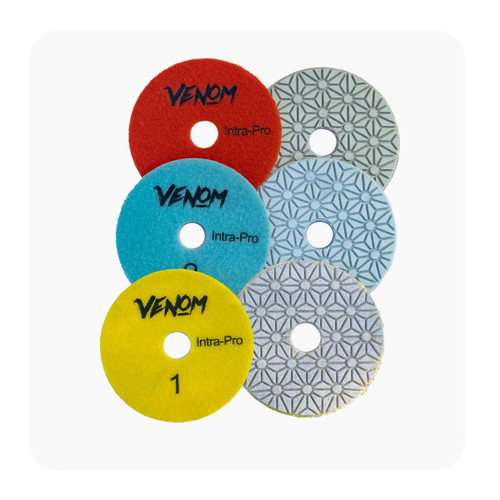
The Venom Ceramic 3-Step Diamond Polishing Pads were developed after one of Venom’s partner factories introduced a new ceramic resin formulation and asked Venom to experiment with it in real-world fabrication conditions.
The goal of the testing was to compare this new ceramic resin directly against existing hybrid resin systems and Black Mamba resin, focusing primarily on edge performance, consistency, and control.
During testing, the ceramic resin was found to run edges essentially the same as Venom Hybrid, delivering predictable cutting, smooth transitions, and dependable results. What surprised both the factory and fabricators, however, was how much better the ceramic resin performed on surface work.
In real-world use, the ceramic resin consistently outperformed hybrid resin on:
-
Surface scratch repair
-
Blending and touch-ups
-
Flat surface polishing
-
Overall surface clarity
As a result, this ceramic resin system evolved into a pad that could be used confidently for both edge polishing and surface polishing, even though surface use was not the original design goal.
Ceramic Resin Performance (Factory-Driven Discovery)
The ceramic resin used in Venom Ceramic was not designed to replace hybrid pads or Black Mamba pads. It was introduced as an experimental resin and evaluated side-by-side with existing Venom systems.
Through testing, Venom discovered that this ceramic resin:
-
Performs similarly to hybrid resin on edges
-
Outperforms hybrid resin on surface polishing
-
Allows effective surface scratch repair and blending
-
Produces higher clarity on flat surfaces
This made the ceramic resin uniquely suited for shops that want a pad that behaves like a hybrid on edges but delivers superior results when surface work is required.
Same Pad as Venom Bite — Only Identification Differences
Venom Ceramic and Venom Bite use:
-
The same ceramic resin formulation
-
The same diamond quality
-
The same polishing behavior
-
The same edge and surface performance
They are the same pad.
The only differences between Venom Ceramic and Venom Bite are:
-
A different pad mold
-
A different Velcro color-coding sequence
These differences exist only for workflow organization, allowing shops running multiple Venom pad systems to quickly identify pads and avoid mixing systems during daily production.
Performance is identical.
Results are identical.
Only identification differs.
Pad System Layout
Coarse → Step 1 → Step 2 → Step 3 → High Gloss
Steps 1–3 define the core system.
Coarse and High Gloss are optional depending on material condition and desired finish.
Key Features
-
Ceramic resin diamond polishing technology
-
Factory-introduced experimental ceramic resin
-
Runs edges like Venom Hybrid
-
Outperforms hybrid resin on surface polishing
-
Excellent surface scratch repair and blending
-
Same performance as Venom Bite
-
Designed for natural stone and hard surfaces
-
Works on quartz, quartzite, granite, marble, porcelain, Dekton, and compact surfaces
-
Sold and recognized as a true 3-step polishing system
-
Optional Coarse pad for additional stock removal
-
Optional High Gloss pad for added clarity and shine
-
Different mold and Velcro color system for pad identification
-
Wet-use only for best results
Wet-Use Design
Venom Ceramic polishing pads are designed for wet use. Proper water flow helps:
-
Control heat
-
Promote even resin breakdown
-
Extend pad life
-
Deliver consistent edge and surface finishes
Ceramic resin responds best to steady pressure and consistent water during both edge polishing and surface blending.
Primary Applications
-
Quartz countertops
-
Quartzite (natural stone)
-
Granite and marble
-
Porcelain slabs and tile
-
Dekton and compact surfaces
-
Edge polishing
-
Surface scratch repair
-
Blending and touch-ups
-
Flat surface polishing
Specifications
-
Resin Type: Ceramic Resin
-
Use: Wet polishing only
-
Diameter: 4 Inch
-
Attachment: Velcro
-
Machine Compatibility: Hand grinders, edge machines, line polishers
RPM & Usage Notes (LOCKED STANDARD)
-
Recommended average speed: ~3,500 RPM
-
Common working range: 2,000–5,000 RPM
-
Maximum speed: Do not exceed 5,000 RPM
Available Grits
Coarse • Step 1 • Step 2 • Step 3 • High Gloss
1 Review Hide Reviews Show Reviews
-
These Pads are Awesome!
We use these for everything! Every Stone, Every Edge, Every Time! Even surface polishing with these is a breeze! Highly Recommend!