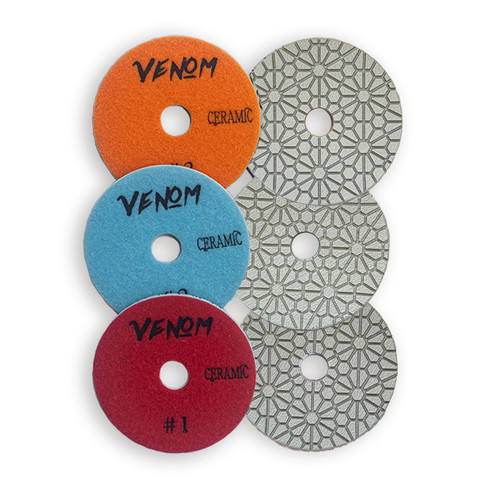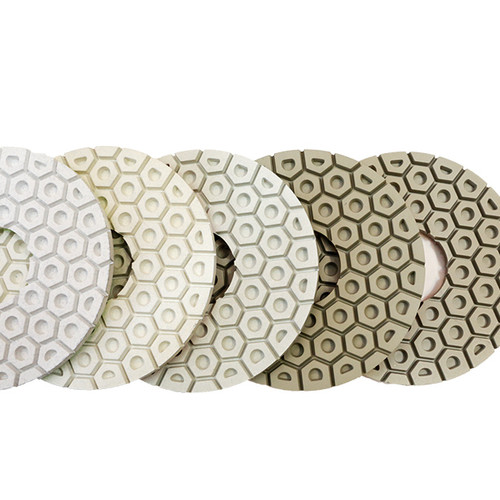


Product Description
The Venom Ceramic 3-Step Diamond Polishing Pads were developed after one of Venom’s partner factories introduced a new ceramic resin formulation and asked Venom to test it under real stone fabrication conditions.
The purpose of the testing was to compare this new ceramic resin directly against existing hybrid resin systems and Black Mamba resin, focusing primarily on edge performance, consistency, and operator control.
During testing, the ceramic resin performed nearly identical to Venom Hybrid pads on edges, delivering smooth transitions, predictable cutting, and reliable polishing control.
What surprised both the factory and fabricators, however, was how much better the ceramic resin performed on surface work.
In real fabrication environments, the ceramic resin consistently delivered improved performance on:
-
Surface scratch repair
-
Flat surface polishing
-
Surface blending and touch-ups
-
Overall surface clarity
Because of this unexpected strength on surfaces, the ceramic resin system evolved into a polishing pad that can confidently be used for both edge polishing and surface polishing, even though surface use was not the original design goal.
The result is a versatile polishing system that fabricators can rely on for both edge work and surface work, making it especially useful for repair work, scratch removal, and blending on installed countertops.
Ceramic Resin Performance (Factory Testing)
During testing, ceramic resin demonstrated several characteristics that separate it from traditional resin bonds:
• Higher heat tolerance compared to standard resins
• More stable diamond exposure during polishing
• Improved surface clarity on flat polishing
• Consistent edge transitions during multi-step polishing
These characteristics make ceramic resin an excellent solution for fabricators who want predictable polishing on both edges and flat surfaces without switching pad systems.
3-Step Polishing System
The Venom Ceramic system uses a simplified 3-step polishing process designed to reduce polishing time while still delivering professional results.
Typical progression:
-
Step 1 – Cutting / Initial Polish
-
Step 2 – Refinement
-
Step 3 – Final Gloss
Optional pads that can be added depending on the job:
-
Coarse Pad (for heavy shaping or deep scratch removal)
-
High Gloss Pad (for maximum shine on darker stones)
This streamlined system helps fabricators reduce polishing time while maintaining consistent finishes.
Common Uses
The Venom Ceramic 3-Step Pads are commonly used for:
-
Edge polishing on countertops
-
Surface polishing
-
Scratch removal and repair work
-
Blending seam areas
-
Touch-up polishing on installed countertops
-
Flat polishing on granite, quartz, marble, and quartzite
Because of their surface performance advantage, many fabricators also use these pads specifically for surface restoration and scratch repair.
Product Details / Specifications
• Pad Diameter: 5 Inches
• Mounting: Hook & Loop (Velcro Backed)
• Bond Type: Ceramic Resin Bond
• Wet or Dry Use: Wet Recommended
• Tool Compatibility: Variable Speed Polishers
RPM Recommendations
Recommended Operating Speed:
• 2,000 – 5,000 RPM working range
• 3,500 RPM recommended
• 5,000 RPM maximum
Following proper RPM ranges helps maintain pad life and ensures optimal polishing performance.
Available Steps
The Venom Ceramic polishing system is available in:
• Coarse (Optional)
• Step 1
• Step 2
• Step 3
• High Gloss (Optional)
Materials
Designed for polishing:
-
Quartz
-
Granite
-
Marble
-
Quartzite
-
Engineered stone
-
Natural stone